
The Wolf Pack Power Brief ·
How does a startup nobody has heard of land its first big customer?
Big buyers sign unknown startups when their champion can defend the choice. The checkpoints, the PROOF and five moves to land your first big customer.
- By Paulo Veloso
- 6 min read
The big customer likes the product. The pilot went fine. And nobody will sign.
I see founders ask some version of this every week: "We're small and new. How do we get a big company to trust us?"
My answer: the buyer is scared of being stranded. Give the person who picked you a path they can defend inside their company, in writing, and the size question gets quiet.
Key takeaways
- The person who picks you carries the risk inside their company. Your job is to make that choice easy to defend.
- Trust gets built at three checkpoints on the Trail, and each one is something the buyer did, on the record.
- The security review is the slowest step for big buyers. Put it on the calendar before they ask.
- Sell one use case with a first step the buyer can approve.
- Nothing goes in commit until the person who can say yes has confirmed it in writing.
Why won't a big company buy from a startup?
I spent part of this week reading founder and buyer threads on this exact question.
In one, people talked about why they hesitate to install software from new, small or AI built products. The reasons came up again and again: it gets abandoned, nobody answers when it breaks, nobody checked the security, and there's no track record.
In another, a buyer said he wants a vendor with about two years of history before his business depends on it. Others said that once a company relies on a tool, it buys the established name.
Read those again. Every one of them is about what happens after the signature.
The security point shows up in the data too. In G2's 2026 buyer research, IT security review was the single biggest source of delay, for 39% of buyers overall and for 50% of enterprise buyers.
What is the buyer really afraid of?
Someone inside that company has to put their name next to yours.
If you disappear next year, or the product breaks and nobody picks up, it's their call that looks bad. That's the risk they carry, and no feature list covers it.
I've spent more than 20 years building and scaling revenue teams, from startups chasing their first customers to global enterprise brands. My view from that: a stalled first big deal usually has a happy user, a nervous signer and nothing on paper.
So the job is to give that signer paper.
How do you earn trust before the buyer signs?
This is the Trail in The Wolf Pack Power Framework, the GTM framework I install with revenue teams. The first leg of the Trail is called Earn trust, and it runs through checkpoints. A checkpoint is always something the buyer did, on the record. A rep's confidence moves nothing.
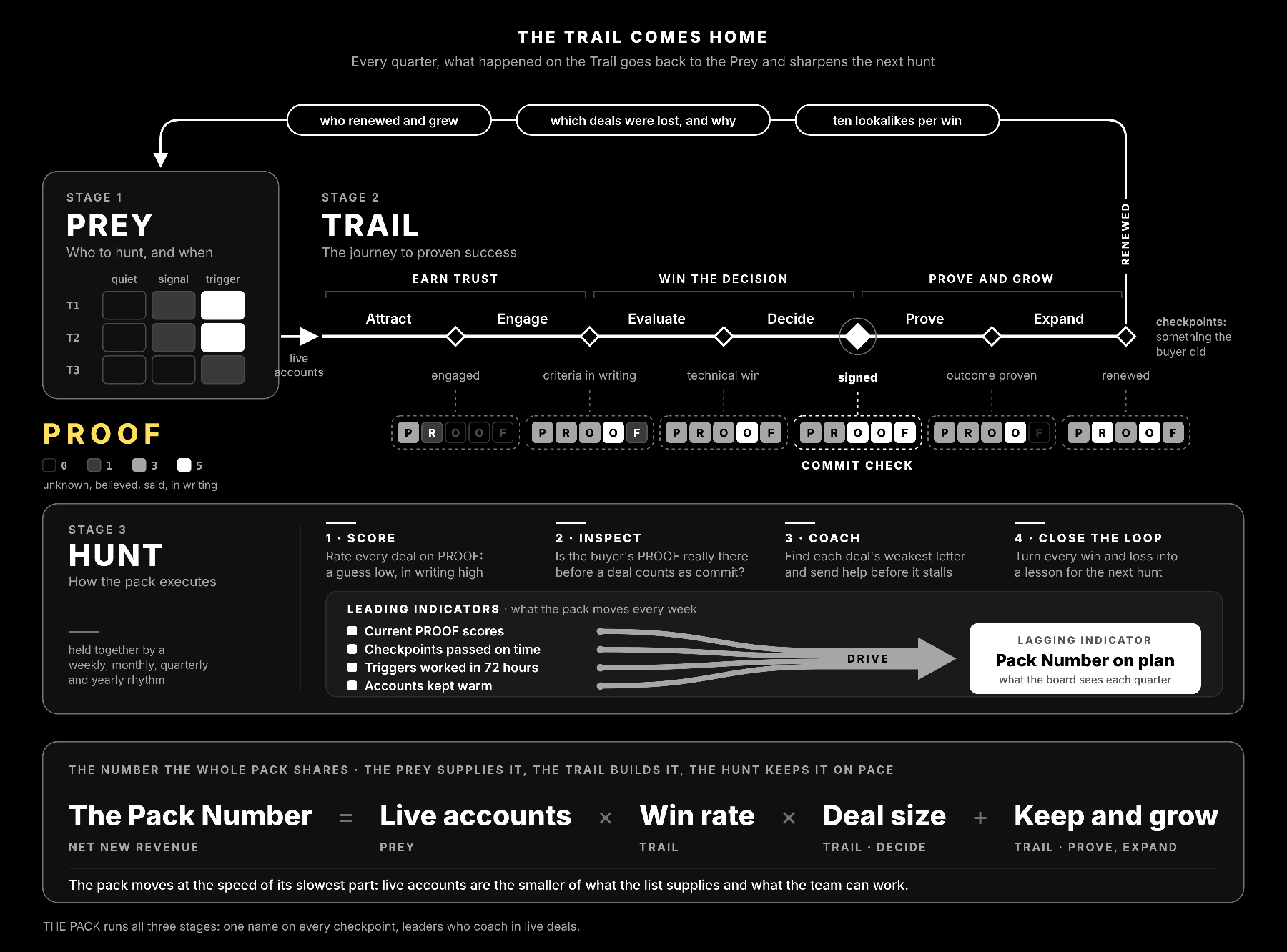
The Wolf Pack Power Framework at a glance.
Here are the three that matter most for an unknown vendor:
- Engaged with the problem. The person who owns the problem answers your point of view and books a call that week.
- Agreed success criteria in writing. Their team signs off on one page: what has to improve, by how much, by when.
- Confirmed the technical win. Their engineers test you against that page in 45 days or less and sign the readout, with the security review cleared or dated.
Each one gives your champion something to show their boss. That's what a small vendor is missing, and it's the part you control.
What should you send before the buyer asks?
Five moves I'd run on Monday:
- Put a named executive and a phone number on the deal. The buyer's biggest fear is calling and getting nobody. Answer it before it comes up.
- Get the success criteria on one page, signed by their team. A pilot with no written criteria gives you a happy user and no decision.
- Send the security pack in week one and ask for a date on the review. It's the slowest step for big buyers, so start it first.
- Scope one use case with a first step they can approve. When I was leading sales, we ran a use case selling program for this reason: one defined use case, adopted fast, then grow from there.
- Write the continuity answer before they ask. Who supports them, how they get their data out, what happens if you're acquired, and two customers they can call.
When is a big deal really commit?
When I was leading sales, nothing reached commit without five answers. No answers, no commit.
The framework writes that down as PROOF, five letters every team uses to score the same deal: Problem, Reason now, Owner, Outcome, and Funding and path. Each letter gets scored on where the answer came from. A 1 is our own guess. A 3 means the buyer said it. A 5 means it's in writing.
A deal counts as commit only when it passes the Commit Check:
- It scores 20 or more out of 25.
- Owner is at 5: the person who can say yes has confirmed it in writing.
- Outcome is at 5: the success criteria are agreed in writing, and the test against them is signed.
- Funding is at 3 or better: the buyer has told you the budget and the path to approve it.
- No letter is below 3.
For an unknown vendor, the path is where deals go quiet. The security review and procurement are part of Funding and path, so score them like everything else.
The other side: should a startup chase big customers this early?
Plenty of good operators say no. Win smaller customers first, because a big logo can eat your roadmap and your runway while procurement takes its time.
That's a fair point, and if you can't staff a long deal, I'd listen to it.
The honest exception to my own advice: if the buyer's problem is on fire and you're the only fix, they'll sign a small vendor fast and skip half of this. Keep the PROOF anyway. The renewal will ask for it.
What would change my mind: seeing big buyers pick unknown vendors on product alone, with support and continuity nowhere in their reasons.
What this means for your plan
Founders: pick the one big logo that matters most this quarter. Check which of the three checkpoints it has passed, on the buyer's record. Put the security review on the calendar this month.
First sales leaders: add the continuity answer to your deal kit, and keep any big deal out of commit until Owner and Outcome are in writing.
FAQ
Should a startup run a free pilot for a big customer?
Only against success criteria their team signed. Without them you get a happy user and no decision.
How long should a first enterprise evaluation take?
Keep the technical test to 45 days or less, and put a date on every step after it. Long cycles come from undated steps.
What goes in a security pack?
Your answers to their questionnaire, your policies, how you handle their data, who to call in an incident, and any audit report you have. If you don't have an audit yet, say when you will.
Do I need references before my first big customer?
Use the customers you have, even small ones, plus a named executive the buyer can call.
That's it.
Hit reply and tell me what stopped your last big deal from signing. I read every one. If this was useful, subscribe, send it to one founder chasing their first big customer, and DM me if you want a second set of eyes on your big logo plan.
Let's go build something that sells.
PAULO Veloso
Sources: Hacker News threads on trusting software from new and AI built products (October 14, 2026) and on whether SaaS is dead (October 21, 2026); G2, 2026 Buyer Behavior Report (July 22, 2026; 1,000+ B2B software buyers and decision makers).
Keep going
Want more like this, and a way to use it?
Join the free founding pack, or grab a blueprint you can work through today.
Also published on LinkedIn .