
The Wolf Pack Power Brief ·
When should a founder hand off sales to a first rep?
Still closing every deal yourself? Count decided deals, write down the five answers on each, and hand off sales when a stranger could run your next deal.
- By Paulo Veloso
- 7 min read
I'm still closing every deal. When do I hand this off?
Some version of that question reaches me every week. This week it showed up in hiring posts too: startups opening their first or second sales role because the pipeline grew faster than one person could work it.
My answer: count decided deals, and hand off when a stranger could run your next deal from what you wrote down. Until then, keep selling and keep writing.
Key takeaways
- Count decided deals: won, lost and no decision. Under 20, keep selling and write everything down.
- A new rep can only copy what exists outside your head, so the paper comes before the hire.
- Score every deal on five answers. Your own opinion scores a 1, the buyer's word a 3, and the buyer's writing a 5.
- Hand off the closing. Keep the weekly coaching of the deals in trouble, and keep talking to customers.
- If buyers trust you personally, hand off the prep and the follow up first and keep the call.
Why is transitioning from founder led sales so hard?
Because it works. In a September 2026 survey of 300 software GTM leaders by Growth Unhinged and GTM Strategist, with a typical respondent between $1M and $10M ARR, founder led sales was the top motion for companies under $1M ARR (44%) and the second most common from $1M to $10M ARR (26%). It even hung on into the $10M to $50M range. The author's read: it works early, and growth tends to slow without a more repeatable motion.
So you're not late. You're in the stage almost every company goes through. The hard part is getting out of it on purpose.
Staying in every deal caps the company at the hours in your week. Handing off too early burns cash and a good seller's first year. Both mistakes come from the same gap: nobody wrote down how you win.
When should a founder hand off sales?
Count decided deals. A decided deal is any deal that ended: won, lost or no decision.
In the framework I use with clients, under 20 decided deals you're proving the motion. The founder and the first sellers sell side by side and write everything down. From 20 to 49 the job becomes making it repeatable, and that's when a sales leader and more reps start to make sense.
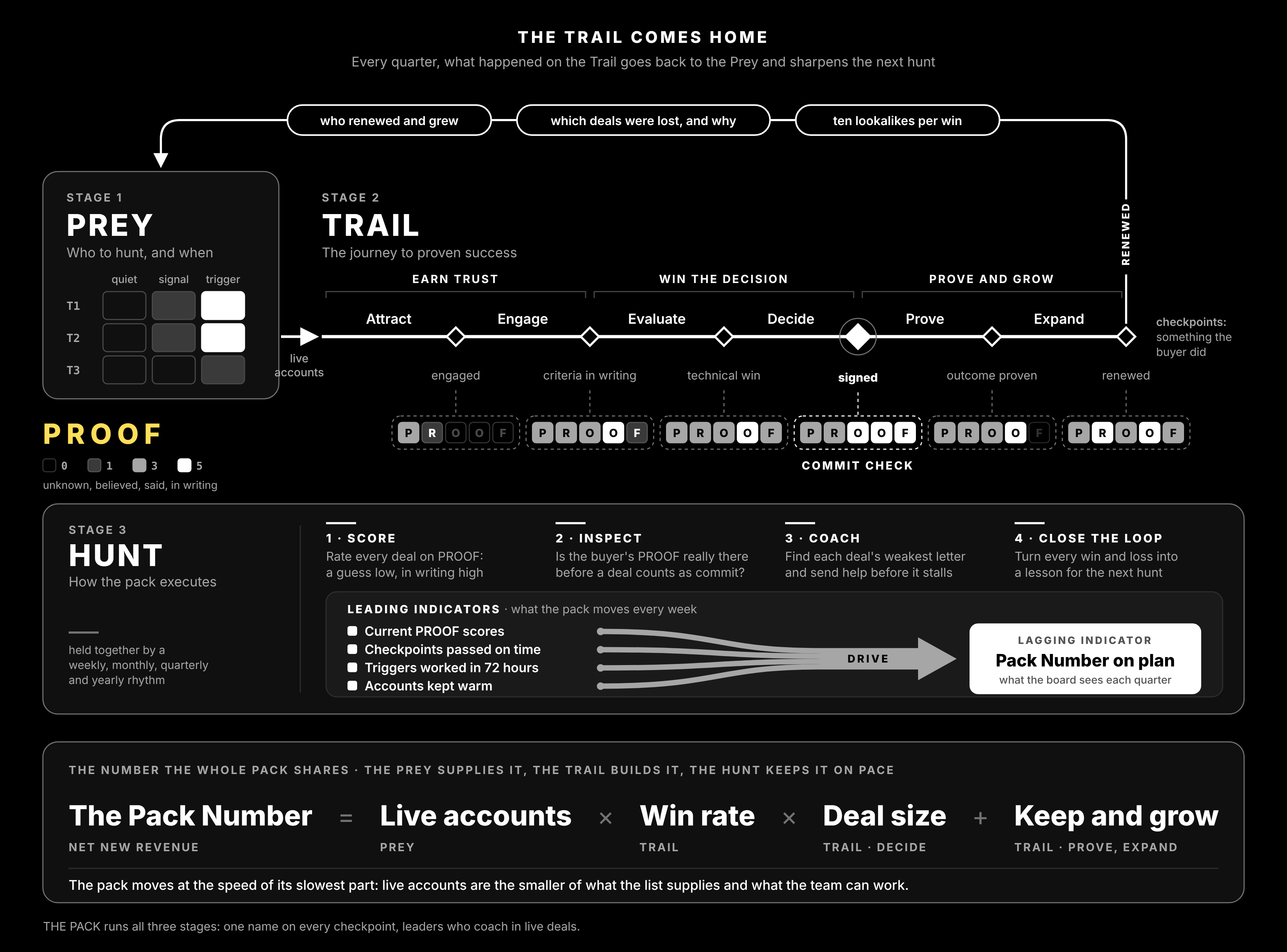
The Wolf Pack Power Framework at a glance. This edition lives in the Trail, where every deal moves on what the buyer proves.
Why count the losses too? They carry half the lesson. A founder with 12 wins and no record of the 30 deals that went nowhere has a story, and a new rep can't learn from a story.
What does a stranger need to run your deals?
Two things, and both live on paper.
The first is one paragraph anyone on the team can repeat: who you win, the problem in the buyer's own words, what starts a purchase, who signs, who can block it, and who you walk away from. Mark each line with how sure you are. Three or more won deals behind it is evidence. One or two is something you've seen. Anything else is a guess, and a guess needs a test, a name and a date.
The second is five answers on every deal, each scored by where it came from. I call them PROOF: the Problem, the Reason they must act now, the Owner who can say yes, the Outcome they agreed in writing, and the Funding and path to signature. Your own read scores a 1. The buyer saying it scores a 3. The buyer putting it in writing scores a 5. A seller's opinion never scores above 1, and that includes the founder.
When I was leading sales, nothing reached commit without five answers: access to power, the procurement process, friction, the technical win and the help needed to close. No answers, no commit. Reps learned to get them early, because a deal without them stayed out of the forecast. The same check works on a founder's own deals, and it hands the first rep something real to copy.
The Wolf Pack Power GTM framework: 5 questions to answer before the handoff
Run these on your own pipeline this week. None of them takes more than an hour.
- How many decided deals do you have? Count won, lost and no decision. Under 20, keep selling and write as you go.
- Could a teammate repeat who you win, from memory? If that paragraph lives only in your head, write it before anything else.
- Do your last 10 deals carry five answers each, with evidence? Put call notes behind every 3 and an email or document behind every 5.
- Could a stranger read your notes and run deal number 11? Save the recordings and notes from your best deal and your worst one.
- What will you keep after the handoff? I'd keep the weekly hour where leaders coach the deals in trouble, and the customer calls. When I was leading sales, I talked to at least 100 customers a year.
What's the strongest case for hiring a rep earlier?
Plenty of good operators give a count. One well known rule says close 20 to 50 deals or reach $1M to $2M ARR, whichever comes first. A venture firm's VP of Sales recently put the floor at 10 customers you closed yourself. Counts are easy to check, they protect cash, and they force a decision.
There's a second argument worth taking seriously. A founder who dreads selling may do more good on product and fundraising, and a seller who arrives early can carry some of the load while the paper gets written.
All fair. I'd still add the paper. Twenty wins nobody wrote down teach a new rep very little, and a customer count says nothing about whether a stranger can repeat them.
When should the founder stay in the deal?
The honest exception: when buyers trust you personally, as a known name in your field, hand off the prep and the follow up first and keep the call. The same goes for a product so new that only the person who built it can explain it.
What would change my mind: founders who hired at a customer count with nothing written down and reached repeatable results as fast as the ones who wrote it first. If that's you, hit reply. I want to hear how.
What does this mean for your plan?
Founders: this week, count your decided deals and score your last 10 on the five answers. Put the paragraph on who you win on one page. Decide what you keep before you decide who you hire. And when you open the role, pay a real base: a commission only founding seller is a stranger funding the experiment you haven't finished.
First sales leaders: before you sign, ask the founder for the deal notes and that one paragraph. If they don't exist, your first 90 days go to writing them, so build that into the plan you agree to.
FAQ
When should a founder hire a first salesperson?
When a stranger could run your next deal from your notes. That usually starts around 20 decided deals, with a written description of who you win and five scored answers on your recent deals.
Should the first sales hire be an AE or a head of sales?
Many operators hire two sellers first so they can compare them, then add a sales leader once both work from the same notes. That's a sound order, and the notes have to exist before either hire.
How long does founder led sales last?
Longer than most founders expect. In the same September 2026 survey it was still common between $10M and $50M ARR. Plenty of founders stay in their biggest deals for years after the first hire.
What goes in a sales handoff package?
Everything the buyer said, agreed and was promised, plus a date to act by. When every handoff carries that package, a new rep starts from the buyer's own words.
That's it.
Hit reply and tell me how many of your last 10 deals a stranger could run from your notes. I read every one. If this was useful, subscribe, send it to one founder who is still closing every deal, and DM me if you want a second set of eyes on your handoff plan.
Let's go build something that sells.
PAULO Veloso
Sources: Growth Unhinged and GTM Strategist, 2026 State of B2B GTM report (published Oct 14, 2026; survey run September 2026, 300 software GTM leaders); Mercury, "How to hand off founder led sales without the guesswork" (Aug 18, 2026); Startup Fortune, "Founder led sales should last longer than most founders want it to" (Aug 11, 2026).
Keep going
Want more like this, and a way to use it?
Join the free founding pack, or grab a blueprint you can work through today.
Also published on LinkedIn .