
The Wolf Pack Power Brief ·
Make sure you are planning your quotas in the RIGHT WAY
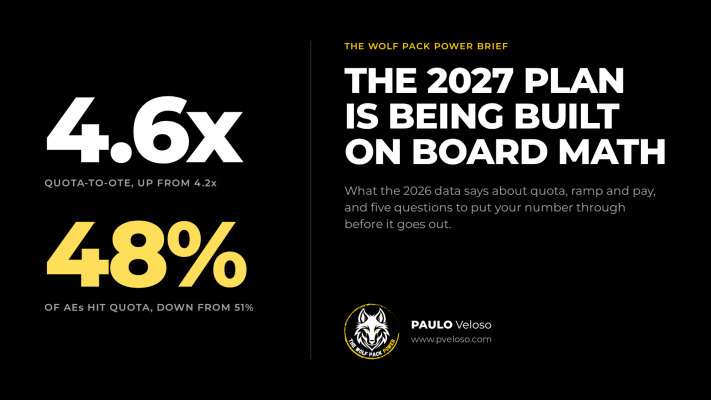
Only 48% of account executives made their number, per the Bridge Group’s 2026 research. Why 2027 quotas should start from rep capacity.
- By Paulo Veloso
- 6 min read

Forty-eight percent.
That is the share of account executives who made their annual number, according to the Bridge Group's 2026 research. It arrives in the middle of planning season, when most of us are about to hand every rep a bigger one.
I want to walk through what the 2026 data says about quotas, because I think a lot of 2027 plans are being built backwards: start from the board's growth target, divide by heads, and call the answer a quota.
What the data says
The Bridge Group , AE Models, Motions and Metrics (June 23, 2026). 158 B2B companies, surveyed online in Q1 and Q2 2026; respondents were VPs of sales, CROs, RevOps leaders and CFOs; medians reported.
- 48% of AEs hit annual quota, down from 51% in 2024.
- Median OTE $200K, up from $190K in 2024 and $167K in 2022.
- Quota-to-OTE ratio 4.6x, up from 4.2x in 2024.
- Ramp time 6.2 months, the highest in the study's history.
- Experience required at hire 3.7 years, up from 2.7 in 2022.
- 38% of AEs now hold sole or blended ownership of renewal and expansion, nearly double 2024.
- Companies in the top third for AI engagement reported 57% attainment; the bottom third, 39%.
- Compared with Q1 2025, near-majorities reported more stakeholders, longer cycles, more discounting pressure, more slippage and higher pipeline coverage requirements.
Xactly Corp , 2026 State of Sales Compensation (February 11, 2026). Built on more than 20 years of Xactly's proprietary compensation data, analyzed over the last five years.
- The pay gap between 25th and 90th percentile AEs reached nearly $200,000 in 2025.
- AEs with one to three years of experience saw OTE decline at every percentile; those with five or more years gained about $26,000 on average.
- Xactly's own summary: compensation is shifting from fueling growth to managing risk.
Gartner (July 28, 2026). Survey of 210 chief sales officers. 60% say their revenue number is largely driven by factors outside their control.
PredictLeads (September 17, 2026). 58,319 US sales and RevOps postings. AE and field sales postings fell 8.3% in one month, from 45,266 to 41,525, while total US postings rose 5%.
Each AE costs more, carries more quota per comp dollar, needs more experience to be hired, takes longer to ramp, sells into longer cycles with more people in the room, and makes the number less often.
The strongest case for the stretch plan
Here is the other side, argued properly, because it is not a straw man.
Quotas are supposed to be hard. Attainment below 50% is not a failure if the company still makes its number, and a stretch plan with steep accelerators pays the top performers who carry most of the bookings anyway. Xactly's data says companies are already concentrating pay on those people. CFOs under efficiency pressure will not approve headcount at 4.2x when a competitor runs at 4.6x. And the AI data says productivity is really rising: 57% attainment in the most engaged third of companies. Plan for the team you will have next year, not the one you had last year.
Some of that is right. Stretch has a place, and the AI gap is too large to ignore.
But two things break it. First, when fewer than half the reps make the plan, the quota has stopped being a target and become a forecast error, and you pay for that error in attrition. Every AE who leaves after a missed year costs you another 6.2 months of ramp and a hire from a pool that now demands 3.7 years of experience. Second, the 57% versus 39% gap compares companies that chose to adopt early. Those tend to be the teams that already ran tighter. Putting that gap into quota before it shows up in your own reps' numbers means spending productivity you have not measured.
My position: build 2027 quotas on capacity math, and let the AI upside land as overachievement. I would be wrong if companies that hold 4.6x plans post higher total bookings and lower AE attrition through 2027 than the companies that reset. I will check that data when it comes out.
Five questions before the number goes out
In every team I have run, no deal reached commit without five answers: access to power, the procurement process, the friction, the technical win, and the help needed. No answers, no commit. A quota is a commit you make to your board, so I put it through the same gate.
- Access to power: who built the number, and from which direction? If it came only top-down, from the growth target divided by heads, it is a hope. Build it bottom-up from what your ramped reps actually produced, then show the board the gap between the two.
- Procurement process: what does your real hiring calendar do to capacity? With a 6.2-month median ramp, an AE who starts in April delivers well under half a year of fully ramped output in 2027. Most capacity models I review still count that rep for three quarters.
- Friction: what slowed your deals this year, and did you price it in? More stakeholders, longer cycles and more discounting mean the same pipeline closes later and smaller. If your coverage requirement went up, the quota should reflect it.
- Technical win: what productivity have you measured, not bought? Only put AI gains in the quota that show up in your own attainment data, rep by rep. Everything else goes in the upside case.
- Help needed: what does each rep need to make it? Territory, pipeline coverage, SE hours, enablement time. If the plan assumes 4x coverage, name who produces it.
Check our PODCAST
What this does to your plan
If you are a CRO, take two numbers into the planning meeting: the board number and the capacity number. Show the gap between them and what closes it: hiring timing, pricing, expansion, or new channels. Given that 38% of AEs now own expansion, model the expansion number separately; it runs on a different conversion rate and a different cycle. And put some of the stretch in manager overassignment rather than loading it onto every rep.
If you are a founder, ask for the attainment distribution, not the average, and for a ramp-adjusted capacity model. A plan where 48% of reps make it and a plan where 70% make it can produce the same average. They do not produce the same attrition.
If you are hiring, notice what the pay data is telling you. When every company only hires AEs with 3.7 years of experience and early-career OTE keeps falling, the pool of experienced AEs shrinks and gets more expensive every year. Someone has to build the bench. Right now almost nobody is.
I will say the uncomfortable part. Most of us have, at some point, set a quota by dividing a board number by headcount and hoping the team would find the difference. I have done it. The 2026 data says the difference is not there to find.
Let's go build something that sells.
Sources: The Bridge Group, AE Models, Motions and Metrics, June 23, 2026; Xactly, 2026 State of Sales Compensation, February 11, 2026; Gartner press release, July 28, 2026; PredictLeads, Sales and RevOps Hiring Statistics, September 17, 2026.
Also published on LinkedIn .