
The Wolf Pack Power Brief ·
FY27 Initiative Reform: why your 2027 sales plan needs fewer initiatives
GTM orgs launch nearly six initiatives a year. 52% get implemented and used consistently. FY27 plans are being built right now, and the initiative list is where you decide the success of next year's number.
- By Paulo Veloso
- 6 min read

Fifty-two percent.
That's the share of GTM initiatives that get implemented and used consistently, according to Highspot's 2026 GTM Performance Gap research.
The average organization runs nearly six a year. Do the arithmetic and most revenue teams keep about three of what they launch. The other three still eat the field's time, the managers' attention and a slot on the enablement calendar.
In the planning cycles I've been part of, the number got the debate and the initiative list got a nod. That list is where FY27 goes wrong, so this edition is about it. I'm arguing for an initiative reform: fewer field initiatives, chosen on purpose, installed before the next one ships, each with a kill date.
What the 2026 data says
Four studies, all from this year, three of them from the last five weeks.
Highspot , 2026 GTM Performance Gap Report (late June 2026). 450 GTM leaders across sales, marketing, enablement and RevOps; six countries, five industries.
- Nearly six GTM initiatives a year on average; 52% implemented and used consistently.
- 53% report highly consistent outcomes.
- 33% say too many competing GTM initiatives contributed to a breakdown in team performance; 42% name fragmented, disconnected technology as a direct cause.
- 76% say AI adoption is moving faster than their operating model can support.
Salesloft , 2026 US Revenue Benchmark (September 2, 2026). 500 US sales and revenue decision-makers at organizations with 200 or more employees, surveyed by Censuswide.
- Every respondent uses AI somewhere in the revenue process; 20.6% call it production-ready with measurable outcomes; 28.2% are still experimenting.
- 68.4% raised pipeline quotas.
- About 32% can instantly diagnose why a deal stalled.
- 26% are actively consolidating their revenue technology; another 32.6% are evaluating.
Gartner , C-suite AI survey (September 1, 2026). 1,303 respondents at organizations with at least $50M in revenue, fielded January to April 2026.
- 22% have scaled AI across multiple business units or adopted an AI-first approach.
- 85% of functional leaders plan to raise AI spending, after putting an average of 12% of their budgets into it in 2025.
- High performers track the return on each initiative and reallocate or discontinue the ones that underperform. They report positive returns on 81% of their AI initiatives. Low performers don't know the return on 29% of theirs.
Boston Consulting Group (BCG) , Applied AI Index 2026 (September 30, 2026). 1,330 CxOs and senior leaders.
- Nearly half of companies now generate real value from AI.
- AI spending doubled in under a year, to 3.3% of revenue, and more than 80% of it sits outside the IT budget.
- The leaders run AI as one enterprise-wide program: clear priorities, workflows redesigned end to end, impact measured in the P&L.
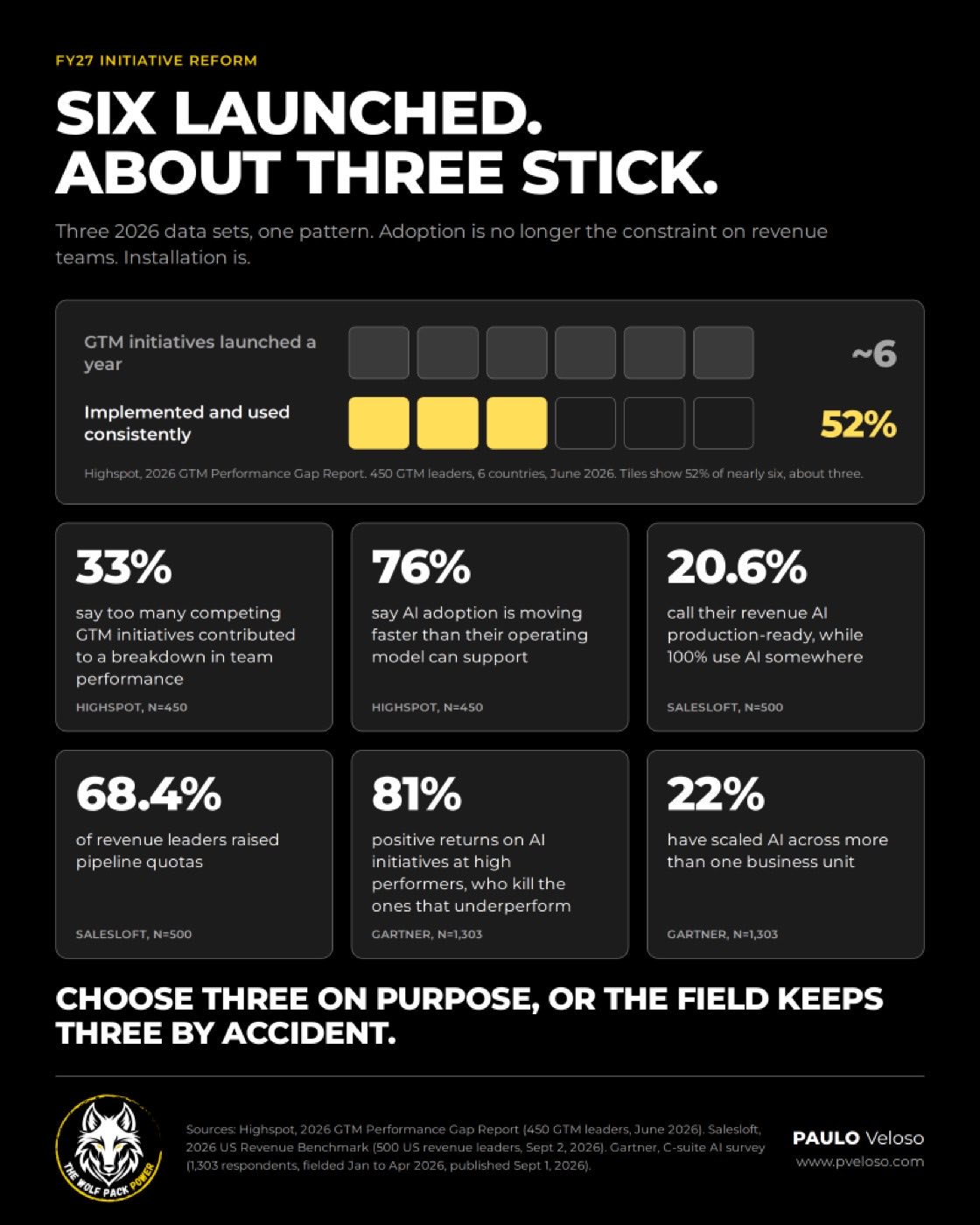
Here's how I read them together. Adoption isn't the constraint anymore. Installation is. The field can absorb a limited amount of change in a year, and the companies getting returns are the ones that ration it.
The strongest case for launching more
I understand the pull of the other side; every CRO feels it in October. So here it is, argued properly.
The market moves faster than any annual plan. BCG's data says AI value is real for nearly half of companies and spending doubled in a year, so a revenue team that launches three initiatives while a competitor launches eight could get lapped. Boards expect an AI program in every function. Highspot's 76% can be read as an instruction to speed up the operating model, not to slow down AI. And pilots are cheap; you find the winners by running many.
Some of that is right. Experiments have a place, and waiting is a decision with a cost.
Two things break it. First, a pilot is cheap for the team that runs it and expensive for the field that absorbs it. Every launch takes manager attention, enablement hours and a line in the pipeline review, and that capacity doesn't grow because the plan did.
Second, look at what the winners in this data actually do. Gartner's high performers kill underperforming initiatives. BCG's leaders run one program with clear priorities. Neither describes six parallel launches into the same field.
My position: cap the FY27 field plan at three initiatives, keep experiments in a separate lane until they earn a slot, and enforce one in, one out.
I'd be wrong if companies launching six or more GTM initiatives a year post better growth and attainment over the next four quarters than the ones running three. I'll check when the 2027 benchmarks come out, and I'll tell you what I find.
Five questions before an initiative reaches the field
When I was leading sales, no deal reached commit without five answers: access to power, the procurement process, the friction in the deal, the technical win, and the help needed to close. No answers, no commit. An initiative is a commit you make on the field's time, so I'd put it through the same kind of gate.
- Who owns it? One named leader, measured on adoption rather than launch.
- What does it replace? One in, one out. If nothing retires, it waits.
- What will a seller do differently on Monday? If you can't describe the behavior, you can't install it.
- Where does it show up in the pipeline review? If the inspection doesn't change, the initiative doesn't exist yet.
- When do we kill it? A date and a threshold, set before launch.
Then comes the installing, and that part is about cadence, not announcements. Four things I've run that do the work:
- Friday micro-learning. At Splunk I ran short weekly field sessions on product and market. That's where I'd install each FY27 initiative: one topic every Friday until it shows up in the pipeline review.
- QBR reform. I changed QBRs from number-checking meetings into improvement sessions. For FY27 I'd add one standing question to them: what did we install last quarter, and is it in the pipeline review?
- Outcome-based field marketing. When we moved field marketing from feature events to CISO conversations about real problems, the regional AEs ran them and I put execution quality into the regional directors' KPIs. That is the difference between measuring a launch and measuring an install.
- Use-case selling. We sold a defined use case to drive adoption and a focused customer journey, instead of the whole catalog. The same logic applies inside your own team. Three initiatives the field can explain beat six it can list.
One more test, from the 100-Customer Journey. I talk to at least 100 customers a year. The best check on a field initiative is whether a customer would ever notice it. If they wouldn't, ask why the field is carrying it.
What this does to your plan
If you're a CRO, ship two lists with the FY27 plan: the three initiatives the field will install, and the ones you're killing to make room. Give experiments their own lane, with a written test to graduate into the field. And with 68.4% of leaders raising pipeline quotas, protect the field's time as carefully as the number.
If you're a founder, ask your revenue leader for three numbers: how many GTM initiatives launched this year, how many are in daily use, and what was retired. The gap between the first two is what next year's plan is about to repeat.
Now the uncomfortable part. Most of us have shipped an initiative in January because it looked good in the plan and let it fade by spring. I have. The 2026 data says the field noticed.
That's it Folks !
Let's go build something that sells.
Sources:
- Highspot, 2026 GTM Performance Gap Report, June 2026: https://www.highspot.com/go-to-market-performance-gap-2026/
- Salesloft, 2026 US Revenue Benchmark, September 2, 2026: https://www.salesloft.com/company/newsroom/salesloft-releases-2026-us-revenue-benchmark-report
- Gartner, C-suite AI survey press release, September 1, 2026: https://www.gartner.com/en/newsroom/press-releases/gartner-survey-finds-only-22-percent-of-organizations-have-successfully-scaled-ai-across-multiple-business-units
- BCG, Applied AI Index 2026, September 30, 2026: https://www.bcg.com/press/30september2026-ai-starting-to-pay-off-companies-generate-value
Also published on LinkedIn .