
The Wolf Pack Power Brief ·
We'll sell to anyone who pays. Is that why we're stuck?
Selling to anyone who pays keeps every deal new. Here's how B2B founders pick an ideal customer profile from who renewed, with a five question fit score.
- By Paulo Veloso
- 7 min read
A founder put it plainly in a thread last week: their team solves a lot of problems, sometimes before customers even ask, so naming the one problem they solve feels impossible.
I hear the business version of this every week. We take every meeting. We sell to anyone who pays. And somehow every deal still feels like the first one.
My answer: pick your prey by who stayed. Pull every customer you've signed, mark who renewed and who grew, and build your ideal customer profile from them. Then say no to everyone else for two quarters.
Key takeaways
- Selling to anyone who pays keeps every deal new. Nothing compounds, and your first rep has nothing to copy.
- Build your ideal customer profile from the customers who renewed and grew.
- In ChartMogul's 2026 study of 1,043 SaaS and AI companies, startups that kept selling to customers paying $300 to $2,999 a month grew 22% a year. Those at $30 to $299 grew 4%.
- Moving upmarket isn't automatically the fix. The startups selling only to the largest customers grew 5%.
- Under 10 paying customers, keep selling wide and write down who comes back.
Why do founders end up selling to anyone who pays?
Because early on, every yes feels like proof. You built something, a stranger paid for it, and turning anyone away feels like turning away oxygen.
So the customer list fills up with companies that look nothing alike. A 12 person agency, a mid market bank, a hospital system, a dev tools startup. Each one bought for a different reason, through a different person, after a different kind of review.
Here's what that costs you. Every deal needs a new pitch. Every onboarding is custom. Every renewal is a surprise, because you never learned which kind of customer stays. And when you hire your first rep, there's no pattern to hand them. They inherit a list of logos and a guess.
The founders stuck here usually have plenty of leads. They just haven't decided who they're for.
What is an ideal customer profile for a B2B startup?
It's the kind of company that buys from you, uses what it bought, renews and grows. All four. A company that signs and churns isn't your prey, however good the logo looks on the website.
In The Wolf Pack Power Framework, this is the Prey: pick the accounts with a problem you can prove you solve and a reason to buy now. The way I'd find yours starts with the customers you already have.
When I was leading sales, I talked to at least 100 customers a year, and I asked my regional leaders to do the same. Those calls told me who renewed and why. That list shaped who we went after next, far more than any persona slide did.
Score every customer you've signed on five questions. Give each a 2 for yes, 1 for partly or unsure, 0 for no.
- Problem fit. Do they have the problem you solve, in a setup you cover?
- Size. Can you serve them profitably at your price?
- Owner in seat. Is there someone there who owns the problem?
- Ability to buy. Can they pay for it, and is there a way to buy?
- Your edge. Do they share the one trait your best customers have in common?
A score of 8 to 10 looks like your best customers. 6 or 7 is a good fit with a gap or two. Anything at 3 or below isn't your prey, and if problem fit is a 0, the total doesn't matter.
Now sort the list by who renewed and who grew. The customers at the top of both lists are your prey. Write one paragraph anyone on your team can repeat: who you win, the problem in their own words, what starts a purchase, who signs, who can block it, and who is not your prey.
Does the type of customer you sell to change how fast you grow?
Yes, and this year we have real data on it.
ChartMogul's analyst in residence, Kyle Poyar, looked at 1,043 SaaS and AI companies that reached $10k in monthly revenue by May 2023 and are still operating, with data through May 2026. He sorted them by what they hunt, using monthly revenue per customer.
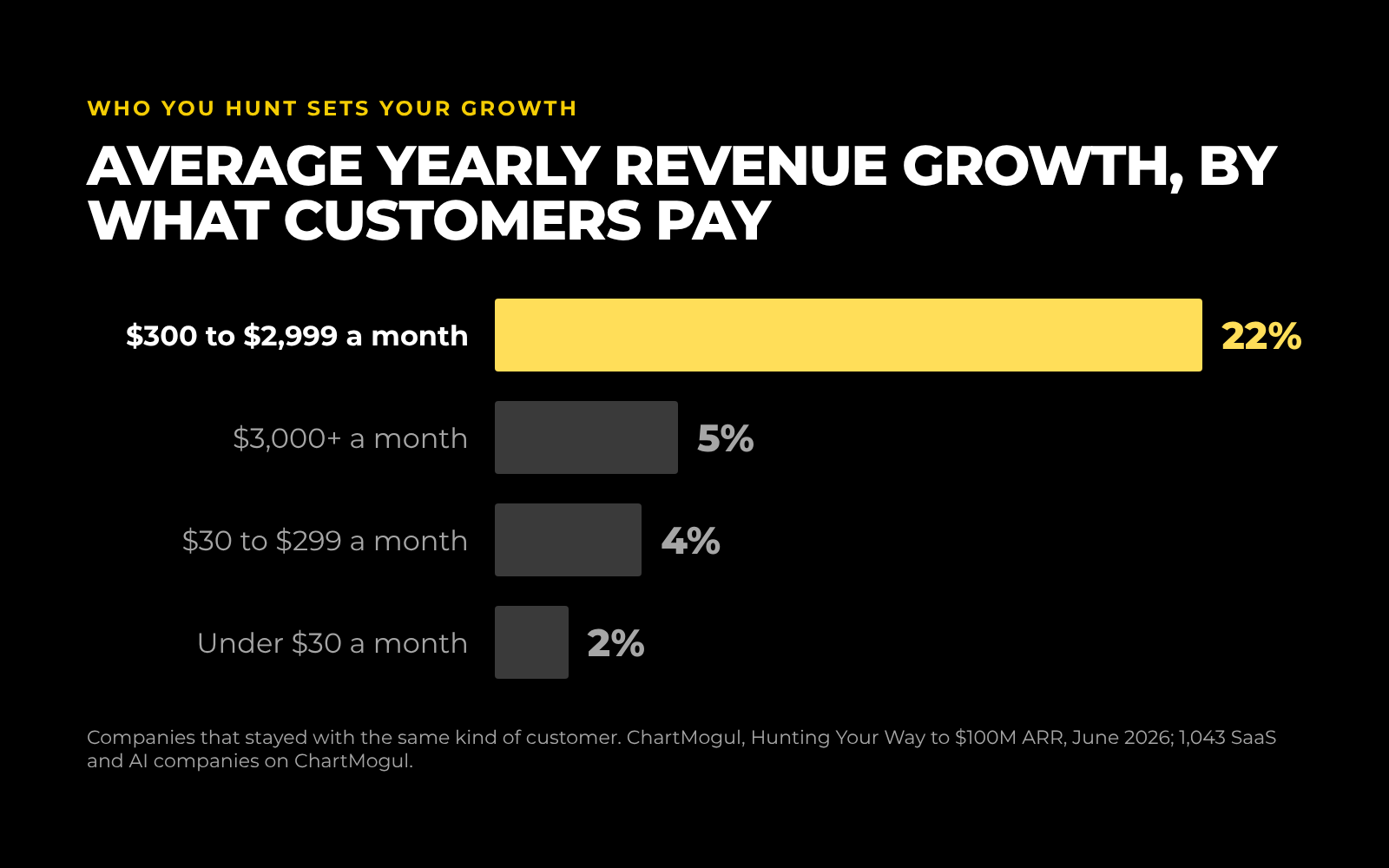
Average yearly revenue growth for companies that stayed with the same kind of customer. ChartMogul, Hunting Your Way to $100M ARR, June 2026.
Companies that kept selling to customers paying $300 to $2,999 a month grew 22% a year on average. Those that stayed with $30 to $299 a month grew 4%, and those below $30 grew 2%.
Retention tells the same story. Early on, at $10k in monthly revenue, the mid sized hunters kept 70.5% of their revenue over a year, before any expansion. The $30 to $299 group kept 31.6%.
And the companies that moved up from the smaller customers to the mid sized ones averaged about 9% growth. Those that moved down averaged minus 11%.
One honest caveat on the data: ChartMogul's customers lean toward self serve and smaller deals, and the author says the sample may not represent every company. If you sell six figure contracts, read the direction, not the decimals.
Should we just move upmarket?
This is where I'd slow down.
Elena Verna made the opposite case well this month: moving upmarket is often a board shortcut. It needs enterprise features, security work, a bigger sales team and long procurement cycles. A team that built a fast product doesn't automatically sell fast to enterprises. She's right that teams reach for it to avoid harder questions.
The same ChartMogul data backs her up on one point. The startups selling only to the biggest customers, $3,000 a month and up, grew 5% a year. Bigger wasn't better. The mid sized hunters won.
My view: go where your renewals point. For some founders that's up. For many, it's a narrower slice of the market they already sell to.
When is selling to everyone the right call?
The honest exception: if you have fewer than 10 paying customers, you don't have enough renewals to read yet. Keep selling wide, and write down who comes back. That list picks your prey later.
What would change my mind? Data showing that startups selling to everyone grow just as fast once they pass the first 20 customers. I haven't seen it.
What this does to your plan
If you're a founder still selling: block one afternoon this week. Pull every customer, score them on the five questions, mark who renewed and who grew. Write the paragraph. Then look at your pipeline and count how many open deals look like your top customers.
If you're the first sales leader: stop judging your pipeline by volume. Ask how many deals match the prey paragraph. Ten deals that look like your best customers beat forty that don't.
If you're about to hire your first rep: hand them the paragraph and the list on day one. It's the only playbook you'll have for a while.
Listen to the full episode
This week's podcast is out: How Founders Should Build Their First Sales Team, with Tammy Schuring, who has taken five companies from early days to growth. Her first move at any new company is the one I'm asking you to make: read every story of how customers got value, then interview whoever closed those deals.
Watch or listen to the full episode
FAQ
What is an ideal customer profile in B2B? The kind of company that buys from you, uses it, renews and grows. Build it from the customers who stayed.
How many customers do I need before I pick an ideal customer profile? About 10 paying customers is where the pattern starts to show. Before that, sell wide and write down who comes back.
What's the difference between an ideal customer profile and a buyer persona? The ideal customer profile describes the company. The buyer persona describes the person inside it who feels the problem and signs. You need both, in that order.
Should a B2B startup move upmarket to grow faster? Not by default. In ChartMogul's 2026 data, startups selling to mid sized customers grew 22% a year, while those selling only to the largest grew 5%. Follow your renewals.
How often should I update my ideal customer profile? Every quarter. Look at what renewed, what was lost and why, and regrade your list.
That's it.
Which customer would you clone tomorrow? Tell me on LinkedIn; I read every message. If this was useful, subscribe to the Brief, send it to one founder who still takes every meeting, and DM me if you want a second set of eyes on your ideal customer profile.
Let's go build something that sells.
PAULO Veloso
Sources: ChartMogul, Hunting Your Way to $100M ARR, Kyle Poyar, June 3, 2026, https://chartmogul.com/reports/saas-startups-become-what-they-hunt/ ; Elena Verna, The growth playbook everyone keeps using, Nov 3, 2026, https://www.elenaverna.com/p/the-growth-playbook-everyone-keeps ; founder thread on Product Hunt, Nov 2026.
Keep going
Want more like this, and a way to use it?
Join the free founding pack, or grab a blueprint you can work through today.
Also published on LinkedIn .