
The Wolf Pack Power Brief ·
Buyers nod in the demo, then go quiet. Is it our positioning?
Buyers nod in the demo, then go quiet? Check your product positioning first. A five question test to see if buyers repeat your value back, with Albert Biketi.
- By Paulo Veloso
- 8 min read
A founder asked a version of this in a thread this week: the calls go well, people say it's interesting, and then the deal goes quiet. Do I need a better pitch, or more follow up?
My answer: check what the buyer can say about you after the call. When buyers nod and then disappear, the deal usually dies in a meeting you're not in, because your champion couldn't explain why it matters now. Fix that first, then worry about the deck.
Key takeaways
- Your champion rarely buys alone. They get a couple of sentences with whoever holds the budget, and your positioning lives or dies in those sentences.
- Position against what the buyer does today, including doing nothing. That's the comparison the budget holder makes.
- A yes won on features can teach you the wrong reason they bought. Find out what got them nodding.
- Positioning gets found in calls, tested in calls and fixed in calls. Change the story only when the calls tell you to.
Why do B2B buyers go quiet after a good demo?
Because the demo was for one person, and the decision belongs to a room.
The person on your call liked it. Then they walked into a meeting with a finance lead, a boss or a steering committee, and they had about two sentences to explain why this matters now. If those two sentences are a feature list, the room asks the obvious question: what happens if we wait? Nobody has an answer, so they wait.
I talked about exactly this with Albert Biketi on this week's episode of The Wolf Pack Power podcast. Albert is the chief product and technology officer at Yubico, and before that he ran strategy for Google's security business, including its acquisitions. He gave me a test I've been using since: at the end of every call, ask yourself what this person will tell whoever holds the budget. If you can't leave them enough to say, the positioning didn't land.
That's the whole problem in one line. The call felt good, and nothing traveled.
What is product positioning, in plain words?
Positioning is who you're for, the problem you solve in their words, why you over the other ways they could handle it, and why now.
Describing your product is a different job. A description tells people what it does. Positioning tells one buyer why they should care this quarter.
Albert's point on the episode was that positioning gets discovered, then tested, then refined. You don't write it once in a workshop. You find it in calls, try it on the next calls, and keep the parts buyers repeat back.
He walked through the ways founders break it. Four of them show up in almost every startup I meet:
- Trying to be everything to everyone. List five problems you solve and the buyer can't tell which one you're great at, so they can't tell when to pick you.
- Leading with features. Sometimes it works, because a sophisticated buyer sees the value before you do. Albert's warning: that yes can teach you the wrong reason they bought, and a buyer who understands the value better than you will price the deal like it.
- Pitching against the other vendor when the real rival is doing nothing. If you never argued against the status quo, there's no urgency, and with no urgency there's no decision.
- Changing the story every month. Buyers need to hear the same thing more than once to remember you. Keep what calls confirm; change only what calls reject.
How do you write a product positioning statement buyers will repeat?
Start from the buyer's words, then check them against your calls.
In The Wolf Pack Power Framework this lives in the Prey, the first stage, where you decide who to hunt. The Prey Statement is one paragraph anyone on your team can repeat: who you win, the problem in the buyer's own words, what starts a purchase, who owns it and who can block it. Your positioning is the part of that paragraph you say out loud.
When I was leading sales, I made myself talk to at least 100 customers a year, and I asked my regional VPs and directors to do the same. My view: that's where positioning comes from. You hear the words buyers use for the problem when nobody is pitching them. We also sold by use case, so the pitch started from a job the buyer already needed done.
Here's the check I'd run this week. I call it the Repeat Back Test. Score each question 2 (yes), 1 (partly) or 0 (no).
- Who. Can you name the one buyer this is for, by role and situation, in a single sentence?
- Their words. Does your pitch use the words buyers used for the problem on your last five calls?
- Today. Can you name what they do now if they buy nothing: the spreadsheet, the extra hire, the late nights?
- Why now. Is there a reason waiting costs them something this quarter?
- Said back. On your last five calls, did the buyer say your value back to you in their own words?
A score of 8 to 10 means keep the story and stop rewriting it. 5 to 7 means fix your lowest answer this week. 0 to 4 means go back to calls before you touch the homepage.
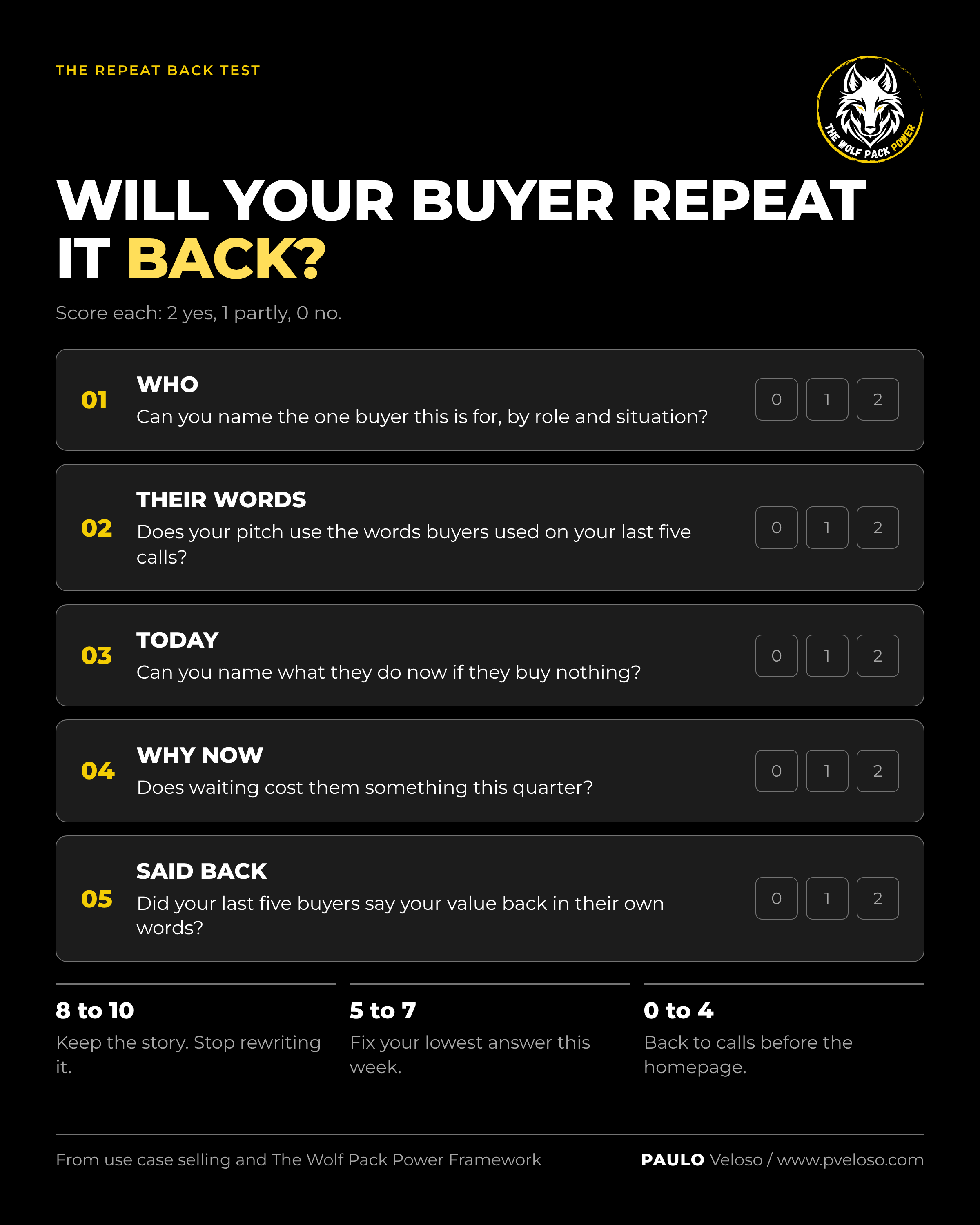
The Repeat Back Test. Score each question 2, 1 or 0.
The fifth question does the most work. Ask it straight on the call: "If you had to explain this to your boss tomorrow, what would you say?" Then stop talking. Whatever comes back is either your positioning or the gap in it.
Should you position against competitors or against doing nothing?
Most founders build the comparison slide first: us next to the two names investors keep asking about.
Here's the strongest case for that. In a crowded category, buyers do compare, and if you don't frame the comparison, a competitor will frame it for you. That's real.
My view is that for a startup under about $20M in revenue, the first competitor is usually the status quo. Albert gave an example on the episode that stuck with me: sometimes the outcome a team wants is to stop working until eight every night and go home at five. If something in their stack keeps them late and you fix it, that's your story. A feature table never says that.
So write the argument against doing nothing first. Then add the competitor comparison for the buyers who already have one.
When is this advice wrong?
When the buyer already has a budget line, a shortlist and a deadline. That's a replacement deal. The decision to act is made, and the open question is who. In that deal, a sharp side by side against the named competitor is the conversation, and arguing against doing nothing wastes their time.
What would change my mind: your own losses. Look at your last ten. If most ended in no decision, position against the status quo. If most went to one vendor, you're in a replacement market whether you like it or not, so position against that vendor.
What this does to your plan
If you're a founder still selling: pull your last five calls this week. Write down the words buyers used for the problem, and what they do today. Rewrite your first two sentences with their words. Leave the homepage alone until five calls in a row say it back.
If you're the first sales or GTM hire: ask for the Prey Statement in your first week. If it doesn't exist, draft it from the calls you sit in and bring it to the founder with the buyer's words attached. Albert made the point that product marketing and sales can come at the story from different angles, as long as everyone knows the whole picture underneath.
If your board asks why deals stall: show them how many of your losses ended in no decision, next to your Repeat Back Test score. That's a better answer than "we need more pipeline."
FAQ
What is product positioning? Who you're for, the problem you solve in their words, why you over the alternatives, and why now.
What's the difference between positioning and messaging? Positioning is the decision about who and why. Messaging is the words you use to say it on a given channel. Get the first one right and the second gets easier.
How often should a startup change its positioning? Only when calls tell you to. Change it every month and buyers never hear the same story twice, so they never remember you.
Is there a product positioning template I can use? Yes. The Repeat Back Test is a one page worksheet with a score page. Get it free on the blueprints page.
Should a technical founder lead with features? With a technical buyer, features earn you the meeting. The budget gets approved on the outcome, so lead with that and keep the features for the evaluation.
Listen to the full episode
Albert and I go further on the podcast: how to tell a product is ready for its first real customers, why product and sales can't tell different stories, what an acquirer checks first when a startup lands on their desk, and when building a company to sell it is the wrong goal.
Watch or listen to the full episode with Albert Biketi
That's it.
Hit reply and tell me what your last buyer would have told their boss about you. I read every one. If this was useful, subscribe, send it to one founder whose demos keep going quiet, and DM me if you want a second set of eyes on your positioning plan.
Let's go build something that sells.
PAULO Veloso
Sources: The Wolf Pack Power podcast, Season 2, Episode 2, with Albert Biketi (recorded Nov 10, 2026); founder threads on Product Hunt and Hacker News, Nov 8 to 12, 2026; The Wolf Pack Power Framework.
Keep going
Want more like this, and a way to use it?
Join the free founding pack, or grab a blueprint you can work through today.
Also published on LinkedIn .